I want to get better at making cakes, so I’ve volunteered to make them for any interested friends to get the practice in. Related, a recent visit to a secondhand bookstore led to my acquiring The Art of Fine Baking by Paula Peck (1961), which contains several classic Northern and Western European cake and pastry recipes of the sort that a proper English grandmother might have in her own collection. These kinds of books have a certain appeal to me, mainly because they completely ignore modern tropes like trendy ingredients (or trendy aversions), moralizing (“guilt-free desserts!” and “clean eating!” and similar), health claims, celebrity chefs, food manufacturer promotions, gadget promotions, and the like, and focus on classic recipes with simple ingredients. Reading them is soothing to me, since I can just focus on the recipes instead of being at the mercy of thousands of dollars of applied marketing psychology.
This book’s recipe for almond butter cake was also intriguing to me because it’s rare to find nuts in cakes these days due to allergy consciousness, and when nuts do end up being involved, it’s pecans, walnuts, hazelnuts, and peanuts (yes, technically they’re not nuts) you’ll run into far more than almonds. Almonds seem quite Old World in comparison. The recipe called for marzipan, some of which I conveniently had left over from the last tea party’s Battenberg cake, so the first person to speak up for my “let me bake for you” offer agreed to let me choose this recipe for his birthday.
Recipe: Almond butter cake
Of course, you can’t have a proper birthday cake without filling and frosting/icing (I don’t know the difference between the latter two, but I’m told it’s regional). I still had a little marzipan left over and I didn’t want to weigh down the cake with a standard American buttercream, so I pulled out my trusty copy of the Culinary Institute of America’s The Professional Chef and looked up its Italian buttercream, which consists of a meringue base with sugar syrup and butter beaten into it.
Recipe: Italian buttercream
After assembling the cake — a bit messily, since I haven’t had much practice decorating pastry — and taking it to its destination party for everyone to have a piece, I made the following observations:
- The sponge was a bit denser than I would have liked, likely due to a certain amount of deflation happening in the whipped egg-and-sugar mixture when I folded in the almond mixture and flour. I would probably add some baking powder to the recipe next time as insurance, even though, strictly speaking, a genoise should be a mechanically leavened cake, not a chemically leavened one.
- The sponge was also a little drier than I’d consider ideal. I’m not sure what about the recipe it is that would account for that; is that what butter cakes are supposed to be like? Should I have let it sit another day before assembling and serving? As it is, I would probably counteract this next time by brushing all of the cake surfaces with a bit of sugar syrup, likely with almond flavouring, both for moisture and for flavour enhancement.
- I chose to flavour the buttercream with a homemade crème de noyaux (cherry pit liqueur) as well as the remaining marzipan. This gave the cake a lovely delicacy of flavour, but considering the robustness of the sponge, a bolder flavour would probably have been better suited to the overall pastry.
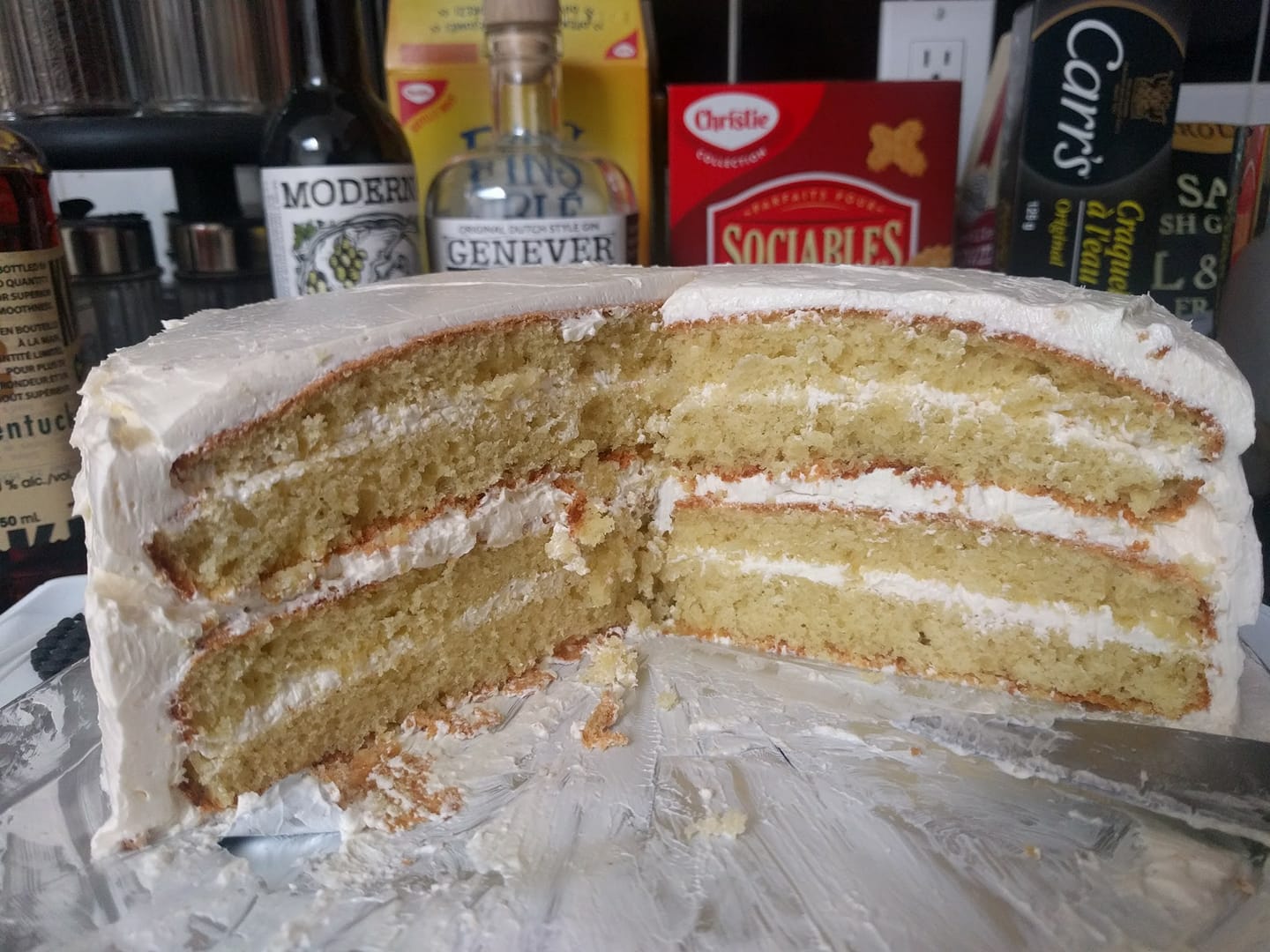
The finished cake’s cross-section.
I may see how this works with almond butter (roasted and raw), though the additional fat in these ingredients may need a lower butter addition, and more sugar will be necessary since nut butters are typically unsweetened. If this works, I don’t see why other nut and seed butters can’t be used as well. Odds are I’ll probably find a cake recipe that is specifically formulated to use nut butters, though, so I’ll hold that thought.